
Two weeks after the new moon, the Moon is full and the sky is at its brightest. That's when many people sit down for a full moon manifestation ritual: a short evening of gratitude for what has moved and a deliberate letting go of what's in the way. The next full moon is on 24 November 2026, and the one after on the night of 23–24 December. Here's how to do the ritual, how to write release statements, and the dates for the year ahead.
Quick answer: Full moon manifestation is a monthly ritual of gratitude and release. Reread your new moon intentions, write what you're grateful for, write what you're ready to let go of, then tear up or safely burn that release list. Close with one affirmation and one action for the rest of the lunar cycle.
What full moon manifestation means
A full moon happens when the Moon sits opposite the Sun as seen from Earth, so its whole sunlit face points toward us. It comes around about every 29.5 days, roughly two weeks after each new moon.
In astrology and modern spiritual practice, that brightness has a meaning. The new moon is the seed; the full moon is the moment of illumination, when what you planted becomes visible. So the full moon isn't usually the time to start a fresh list of wants. It's the time to look at what's come to light, give thanks for it, and release what's slowing you down.
That makes the full moon a useful checkpoint. Halfway through the cycle, you get a natural reason to ask: what's working, and what am I carrying that I could put down?
How to do a full moon manifestation ritual in 6 steps
1. Reread your new moon intentions
If you did a new moon ritual, open that page first. Mark each intention: moving, stuck, or no longer wanted. If you didn't set intentions, write the two goals that are on your mind most this month.
2. Set the space
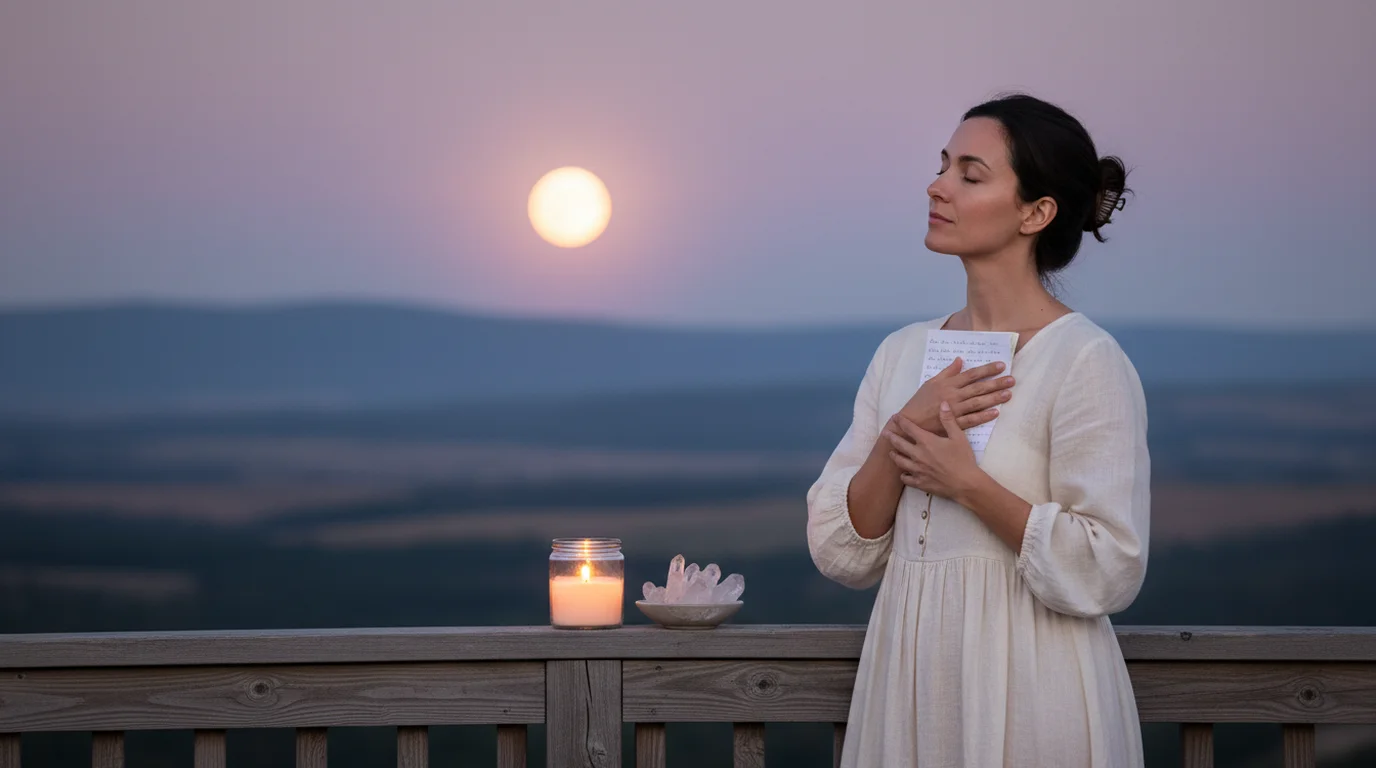
Choose a spot with a view of the Moon if you have one, such as a window or a balcony. Light a candle, sit down and take a few slow breaths. Moonlight is a lovely backdrop; a cloudy night works just as well.
3. Write a gratitude list
Write five to ten specific things from the past two weeks you're grateful for. Specific beats grand: "My sister called on Tuesday when I needed it" says more than "my family". Include any small sign of progress on your intentions.
This is the part of the ritual with the most research behind it. In a 2003 study by Robert Emmons and Michael McCullough, people who regularly listed things they were grateful for showed higher well-being on several, though not all, measures, and the clearest effect was on positive mood (Journal of Personality and Social Psychology).
4. Write what you're releasing
On a separate slip of paper, write one to three things you're ready to let go of. Good release statements are about your own patterns:
- "I'm ready to let go of checking my bank app ten times a day."
- "I release the story that I'm bad with money."
- "I let go of waiting for permission to apply."
- "I'm done replaying last month's argument."
5. Tear it up or burn it safely
Then get rid of the paper. Tearing it into pieces and dropping it in the bin is the simplest option. If you prefer the burning ritual, do it outdoors or over a fireproof bowl, with water close by.
The physical act matters more than you might think. In experiments by Pablo Briñol and colleagues, people wrote thoughts about their bodies on paper. Those who ripped up the paper and threw it away relied on those thoughts less afterwards than people who kept the paper, and the effect was stronger when the action was physical rather than imagined (Psychological Science, 2013). Discarding a written thought helps you discard it mentally.
6. Close with one affirmation and one action
Choose one affirmation for the waning half of the month and one action that follows from your release. Released "waiting for permission"? The action might be sending the application on Monday. Then blow out the candle.
Full moon dates for 2026 and 2027
Times are from NASA's Six Millennium Catalog of Phases of the Moon by Fred Espenak, in Universal Time (UT). In the Americas, a full moon early in the UT day falls on the previous evening local time.
| Full moon | Time (UT) | Note |
|---|---|---|
| 24 November 2026 | 14:53 | |
| 24 December 2026 | 01:28 | Evening of 23 December in US time zones |
| 22 January 2027 | 12:17 | |
| 20 February 2027 | 23:23 | Penumbral lunar eclipse |
| 22 March 2027 | 10:44 | |
| 20 April 2027 | 22:27 | |
| 20 May 2027 | 10:59 | |
| 19 June 2027 | 00:44 | Evening of 18 June in US time zones |
| 18 July 2027 | 15:45 | |
| 17 August 2027 | 07:29 | Penumbral lunar eclipse |
| 15 September 2027 | 23:04 | |
| 15 October 2027 | 13:47 | |
| 14 November 2027 | 03:26 | Evening of 13 November in US time zones |
| 13 December 2027 | 16:09 |
The ritual works on the night of the full moon or the night either side, while the Moon still looks full.
Full moon affirmations
Full moon affirmations lean toward gratitude, completion and trust. Pick one and repeat it each morning until the next new moon:
- "I'm grateful for how far I've come this month."
- "I release what no longer fits and make room for what does."
- "I see my progress clearly and I celebrate it."
- "I let go with ease and keep what matters."
- "Everything I need for the next step is already here."
- "I'm proud of the small steps I took."
Saying one line daily has a simple mechanism: statements we repeat come to feel more familiar and more true, an effect psychologists call the illusory truth effect (Fazio and colleagues, 2015).
Full moon ritual ideas
Keep the six steps as your base and add one of these when it fits:
- Moon water: Leave a glass jar of water on a windowsill overnight and drink it or water a plant the next morning, as a small symbol of carrying the night's clarity forward.
- Crystal cleansing: Many people set crystals in moonlight to "recharge" them. Use it as a moment to hold each one and recall what it stands for.
- Declutter one drawer: A physical release to match the written one.
- Gratitude walk: On a clear night, walk for ten minutes and name what you're thankful for as you go.
New moon vs full moon: how they work together
| New moon | Full moon | |
|---|---|---|
| Symbolism | Beginnings, seeds | Completion, illumination |
| Focus | Setting intentions | Gratitude and release |
| Writing | Two or three intentions | Gratitude list and a release list |
| Action | First step toward each goal | Drop one obstacle |
Used together, the two rituals give you a check-in roughly every two weeks. That's frequent enough to keep goals alive and spaced enough to see real change between sessions.
Carry the gratitude into the next two weeks
The ritual takes one evening, but gratitude builds with repetition. After the full moon, write one or two lines each night about something good from the day. Our gratitude journal prompts help on nights when nothing comes to mind.
If you'd like those lines on your phone, the Manifestly gratitude journal lets you type or dictate an entry and attach a photo, and your affirmation for the month can sit on the Home Screen widget, where each tap counts a repetition.
Write the gratitude list first tonight. The release is easier once you've seen how much is already going right.
Frequently asked questions
What should I do on a full moon for manifestation?
Use the full moon to look back rather than start something new. Reread the intentions you set at the new moon, write down what you're grateful for and what has moved, then name one habit, fear or grudge you're ready to release. Close with a single affirmation and one action for the waning half of the month.
How do you write full moon intentions?
Full moon intentions are usually written as gratitude and release statements rather than new goals. Start with "I'm grateful for…" and list specific things from the past two weeks. Then write "I'm ready to let go of…" and name one pattern. Keep each line short, present tense and about your own choices, so you can act on it.
What to do on a full moon spiritually?
Spiritually, the full moon is read as a time of completion, clarity and release. Common practices include a gratitude list, a short meditation by moonlight, journaling about what has come to light, cleansing crystals on a windowsill, and writing down something to let go of. Pick one or two that feel natural so the ritual stays easy to repeat.
How does the full moon ritual burning paper work?
In the burning paper ritual, you write what you want to release on a slip of paper and burn it as a symbol of letting go. Do it outdoors or over a fireproof bowl with water nearby, never near curtains. Tearing the paper up and throwing it away carries the same symbolism, and research suggests physically discarding written thoughts can reduce their pull.
Can you manifest on a full moon?
Yes, though the emphasis is different. In moon-based practice, the new moon is for setting intentions and the full moon is for gratitude, celebrating progress and clearing what's in the way. Many people find that naming what's blocking a goal, and dropping it, is as useful as writing the goal in the first place.
What are things to do on a full moon for good luck?
Popular full moon customs for luck include charging crystals or a glass of water in the moonlight, writing a gratitude list, decluttering one drawer, and making a wish while looking at the Moon. These are folk and spiritual traditions rather than proven luck boosters. Their practical value is a monthly pause to notice what's going well.
Is it better to manifest on a new moon or full moon?
Both phases have a role. The new moon is traditionally the starting point, when you set two or three intentions. The full moon, about two weeks later, is the checkpoint, when you give thanks, measure progress and release obstacles. Using both gives you two short check-ins a month, which is a sturdy rhythm for any goal.